

Why Image Formats Matter
Choosing the right image format isn't just a technical detail - it directly impacts your website's performance, user experience, and even search rankings. The wrong format can mean bloated file sizes, slow load times, and frustrated visitors. The right format delivers crisp images that load instantly.
In this guide, we'll break down the most common image formats, explain when to use each one, and help you understand the key factors that affect file size and quality.
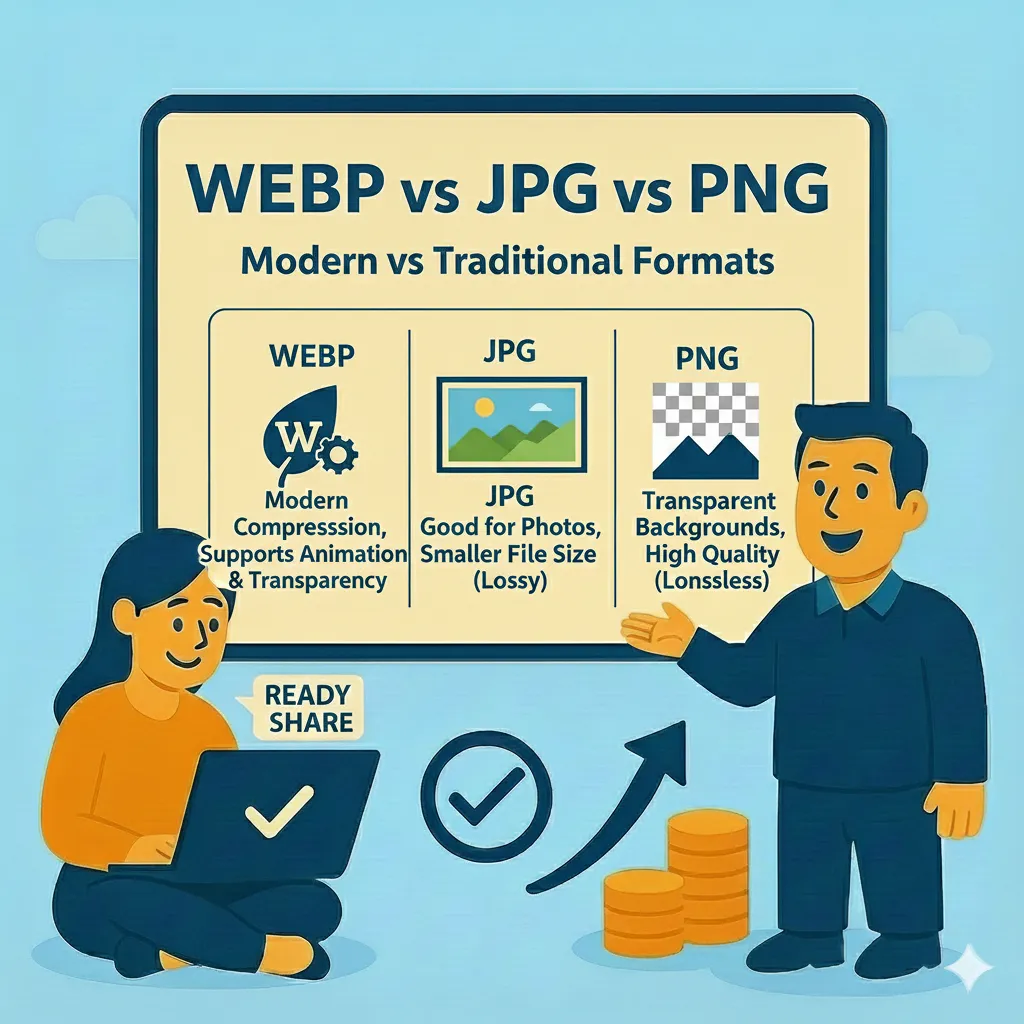
The Big Three: JPG, PNG, and WebP
JPG / JPEG
Best for photographs
- Small file sizes
- Great for photos
- Universal support
- No transparency
- Lossy only
PNG
Best for graphics & logos
- Transparency support
- Lossless quality
- Sharp edges
- Larger file sizes
- Overkill for photos
WebP
Best of both worlds
- Smallest file sizes
- Transparency support
- Lossy or lossless
- Animation support
- Modern standard
Understanding Lossy vs Lossless Compression
The fundamental difference between image formats comes down to how they compress data. Understanding this will help you make better decisions about which format to use.
Lossy Compression
Lossy compression permanently removes some image data to achieve smaller file sizes. The "lost" data is typically information the human eye won't notice - subtle color variations, fine details in busy areas.
Formats:
JPG, WebP (lossy mode)
Best for: Photographs, complex images with many colors, hero images, backgrounds
Lossless Compression
Lossless compression reduces file size without losing any image data. The original image can be perfectly reconstructed. Think of it like a ZIP file for images.
Formats:
PNG, WebP (lossless mode), GIF
Best for: Logos, icons, graphics with text, screenshots, images requiring transparency
What Affects Image File Size?
Three main factors determine how large your image files will be:
1 Dimensions (Width × Height)
The bigger the image dimensions, the more pixels need to be stored. A 4000×3000 image has 12 million pixels - that's 12× more data than a 1000×1000 image (1 million pixels).
Pro tip: Never upload images larger than you need. If your website displays images at 800px wide, there's no reason to upload 4000px originals. Resize first, then compress.
2 Quality Level (Compression Ratio)
For lossy formats, the quality setting directly controls file size. Lower quality = smaller files = more visible compression artifacts.
| Quality | File Size | Best Use |
|---|---|---|
| 100% | Largest | Print, archival |
| 85-90% | Large | High-quality web images |
| 75-85% | Medium | Sweet spot for web |
| 50-75% | Small | Thumbnails, previews |
| Below 50% | Smallest | Low-bandwidth situations |
3 Image Content & Complexity
Images with lots of detail, colors, and gradients compress less efficiently than simple graphics. A photo of a forest will always be larger than a solid color logo at the same dimensions.
Complex Photo
Larger file size
Simple Graphic
Smaller file size
Deep Dive: JPG (JPEG)
JPG (also called JPEG - they're the same thing) has been the web's workhorse image format since the 1990s. It uses lossy compression optimized for photographs and remains the most widely supported format.
When to Use JPG
Great For
- Photographs and realistic images
- Hero images and backgrounds
- Product photos
- Social media images
- Email attachments
Avoid For
- Logos and icons
- Text-heavy graphics
- Images needing transparency
- Screenshots with UI elements
- Images you'll edit repeatedly
The JPG artifact problem: Each time you save a JPG, it recompresses and loses more quality. This is called "generation loss." If you open a JPG, make a small edit, and save it - you've just degraded the image. Always keep original files and only export to JPG as a final step.
Deep Dive: PNG
PNG (Portable Network Graphics) was created as a patent-free alternative to GIF. It uses lossless compression and supports full transparency (alpha channel), making it perfect for graphics, logos, and images that need to overlay on different backgrounds.
When to Use PNG
Great For
- Logos and brand assets
- Icons and UI elements
- Graphics with text
- Screenshots
- Images requiring transparency
- Graphics with sharp edges
Avoid For
- Large photographs
- Hero images
- Backgrounds with gradients
- When file size is critical
PNG-8 vs PNG-24: PNG-8 uses a limited 256-color palette (like GIF) for smaller files. PNG-24 supports millions of colors and full transparency. Most modern usage is PNG-24, but PNG-8 can be useful for simple graphics where you want smaller files.
Deep Dive: WebP
WebP is Google's modern image format, designed specifically for the web. It combines the best features of both JPG and PNG: excellent compression for photos, transparency support, and even animation capabilities.
When to Use WebP
Great For
- Everything on the modern web
- Photographs (lossy mode)
- Graphics and logos (lossless mode)
- Transparent images
- Animated images (replacing GIF)
- When performance matters
Consider Alternatives For
- Email attachments (JPG more compatible)
- Print workflows
- Legacy system integration
- When recipients need to edit the file
Other Formats You Might Encounter
GIF
Limited to 256 colors, supports animation and simple transparency. Largely replaced by WebP for animations and PNG for static images. Still used for simple animated memes due to universal support.
SVG
Vector format (not pixel-based) that scales infinitely without quality loss. Perfect for logos, icons, and illustrations. Not suitable for photographs. Small file sizes for simple graphics.
AVIF
Next-generation format with even better compression than WebP. Browser support is growing (~93%) but not as universal yet. Consider for cutting-edge performance optimization.
HEIC/HEIF
Apple's default photo format on iPhones. Excellent compression but limited web support. Convert to JPG or WebP for web use.
TIFF
High-quality lossless format used in print and professional photography. Huge file sizes - never use for web. Convert to WebP or JPG.
BMP
Uncompressed bitmap format. Massive file sizes with no advantages. Legacy format - always convert to something else.
Quick Reference: Which Format Should I Use?
| Image Type | Best Format | Why |
|---|---|---|
| Photographs | WebP | Best compression for complex images |
| Logos | SVG or WebP | SVG for scalability, WebP if raster needed |
| Icons | SVG | Scales perfectly, tiny file size |
| Screenshots | WebP or PNG | Lossless preserves text clarity |
| Transparent images | WebP or PNG | Both support alpha transparency |
| Animations | WebP | Much smaller than GIF |
| Email attachments | JPG | Maximum compatibility |
| Social media | JPG or PNG | Platform-dependent, check requirements |
Convert Your Images with ScrapeConvert
Now that you understand the different formats, putting this knowledge into practice is easy. Our free ScrapeConvert converter lets you convert any image format to WebP, PNG, or JPG directly in your browser.
100% Private
All conversion happens in your browser. Your images are never uploaded to any server.
Quality Profiles
Choose from lossless, web optimized, social media, or maximum compression presets.
Batch Processing
Convert multiple images at once. Drag and drop a folder of images and convert them all.
Powered by Squoosh
Uses Google's Squoosh library for industry-leading compression quality.
Start Converting Now
Whether you need to convert a single image or batch process hundreds of files, ScrapeConvert makes it fast and simple - no account required.
Open Image Converter